


Denon DP-3000NE Turntable
During my time covering gear for Analog Planet, I’ve reviewed everything from high-end turntables to rugged entry-level decks and even the most esoteric models from around the world. But I’ve not yet had the chance to review a turntable from Denon, the global electronics giant renowned for groundbreaking innovations like the legendary Denon DL-103 moving-coil cartridge, the first THX-EX home theater system (1999), the first viable 8-channel digital recorder (1972), the first Universal Blu-ray player (2008), and, most recently, the world’s first 13.2-channel A/V receiver (2018) — until now, that is.
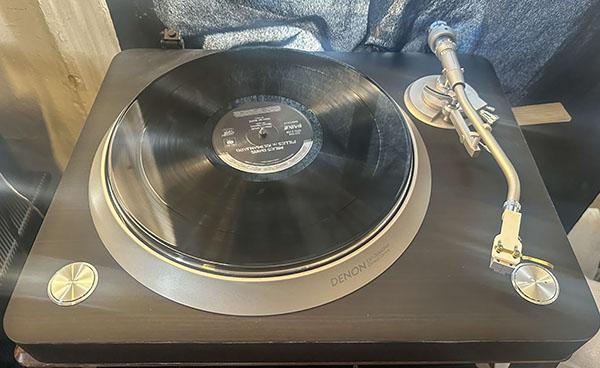
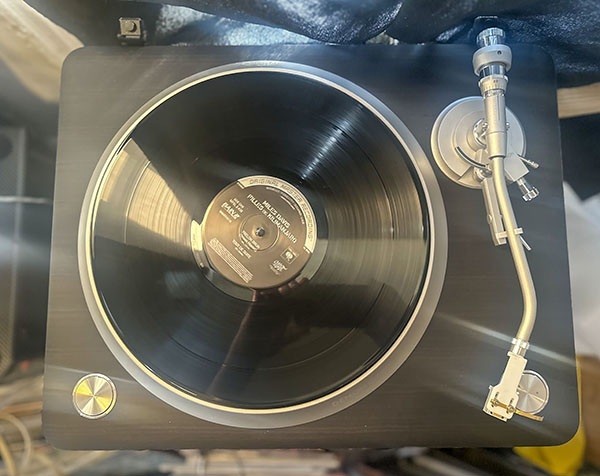
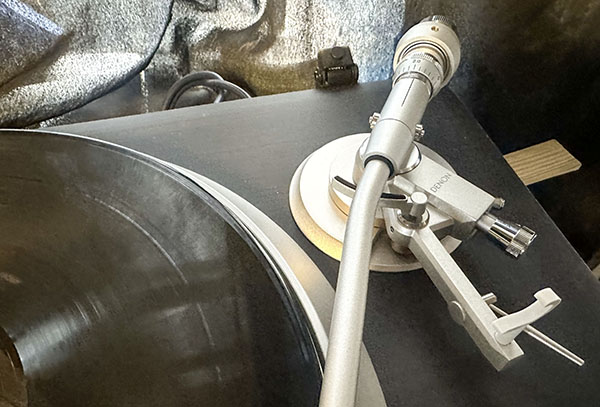
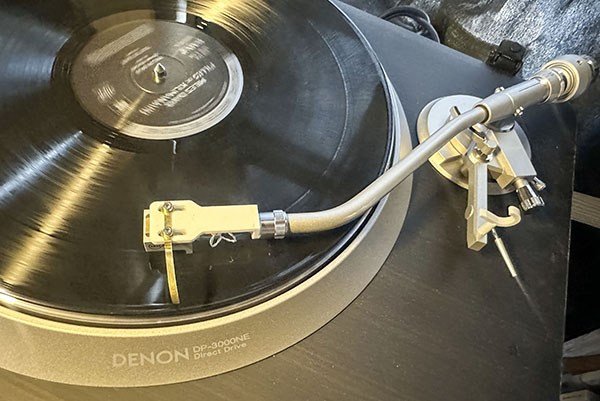
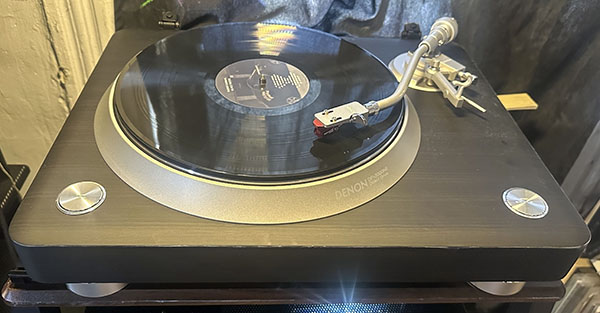
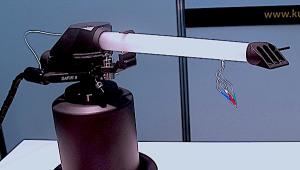
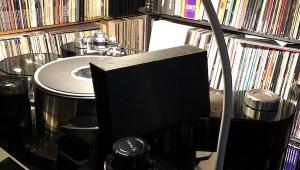
And that leads us to today’s test subject, the Denon DP-3000NE ($2,799), which is the company’s flagship direct-drive turntable. It pairs a static-balanced S-shaped tonearm featuring a brass counterweight and antiskate dial, and a zinc base. An aluminum diecast platter with a stainless-steel plate is powered by a high-torque 16-pole, 12-coil, 3-phase brushless motor. The solid plinth, plinth, made of MDF with veneer and cloaked in dark ebony wood grain, completes its commanding presence and calm composure. (Update: Denon adds that the table was designed in Japan, and made in China.) No frills, just performance — that is the hope, at least.
Features & Specs
The direct-drive design behind the DP-3000NE began in 1970 with the company’s DN302F turntable for broadcast studios, a table that shared a similar pyramid shaped platter plateau with the DP3000NE but was flanked by professional controls. “The DP-3000NE exhibits rotation speed that does not fluctuate no matter the selected speed or load,” according to the Denon site. “It is simple to use, low maintenance, and it reaches full speed almost instantly.” (That last sentence is indeed true.)
The site also noted that the “newly improved Denon tonearm features cartridge weight adjustment, antiskating adjustment (0 to 3g), and a newly developed arm height adjustment (0 to 9 mm). It gives you full flexibility to customize your turntable to your preferred cartridges or custom mat.” To that latter end, the DP-3000NE table came with a very thick rubber mat.
Something Denon calls “space vector pulse with modulation (SV-PWM)” controls the motor. SV-PWM is an algorithm used to control the PWM (pulse width modulation) module, which powers the motor. SV-PWM is said to reduce harmonics in the motor, which reportedly can cause overheating and torque fluctuation. Denon claims it offers a “continuous, reliable voltage and frequency output for long periods of listening at any rotation speed or load via continuous feedback of the rotation speed.”
As with Class D amps, Denon’s switch-mode power supply (SMPS) eliminates the need for bulky linear transformers and external power bricks, cutting vibrations at the source, and perhaps making the turntable run more quietly. Integrated directly into the turntable, it shields against grid fluctuations, ensuring stable voltage and frequency — no compromises, no clutter.
“The feet are key to protect the playback from any vibration picked up from the surface on which the turntable is placed,” the Denon site stated. “The feet are adjustable to bring the platter perfectly in balance for the most accurate needle tracking.” (Update: Denon tells us that the feet consist of silicon rubber, with a coil spring for damping covered by plastic base and aluminum.)
Finally, the Denon DP-3000NE turntable stands at 19.7 x 7.3 x 15.5 in (w/h/d), and it weighs 40.8lb (18.5kg).
Setup
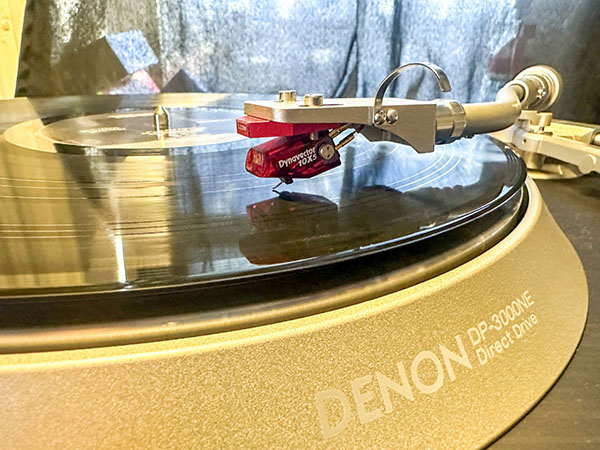
For this review, I used my personal high-end arsenal: Dynavector 10X5 MkII and Kuzma CAR-30 moving coil (MC) cartridges, Manley Chinook and Tavish Audio Design Adagio phono preamps, and a Unison Research S6 integrated amp driving DeVore Fidelity Super Nine gibbon loudspeakers. AudioQuest and Triode Wire Lab cables locked it all together — no weak links, just pure connectivity.
Setting up the DP-3000NE table was quick and effortless, more so than most. The included manual featured clear instructions and helpful illustrations, making the process intuitive. All parts were well-packed and fit together seamlessly. I had the Denon table up and running — and spinning discs — in no time.
Listening Sessions
Let me confess, as I have before: I am one of those sad, hopeful creatures who haunts the listening bars of New York City, spinning jazz records like a man trying to summon the ghost of Miles Davis with nothing but a stylus and a record brush. Kissa Kissa in Crown Heights is my usual haunt — though to call it a pure listening bar, in the hushed, reverent Japanese tradition, would be like calling Times Square a Zen garden. This is New York, after all — on a Friday night, the city’s collective id is too busy howling at the moon to bow its head for a ballad. (Footnote 1)
Still, the Kissa Kissa crowd has a way of leaning in when the right record drops, as if the music were a secret they’d been waiting all week to hear. And I’ve learned, through trial and the occasional public shaming, what makes them stop mid-sentence, and what makes them reach for their phones. So, in the interests of prepping for this particular review, I didn’t just dip into my collection — I went full archaeologist, playing records that never fail to turn a bar full of strangers into something like a congregation. Hence, Bob James’ September 1976 LP Three LP (CTI Records CTI 6063), Carmen McRae’s 1959 effort Book of Ballads (Kapp Records K-1117-S), Yussef Kamaal’s 2016 LP Black Focus (Brownswood Recordings BWOOD0157LP), the 2023 MoFi pressing of Miles Davis’ 1969 album Filles de Kilimanjaro (Mobile Fidelity Sound Lab MFSL 2-438), and Weather Report’s February 1984 masterpiece Domino Theory (CBS 25839) all got the Kissa Kissa nod — and thus, they were the LPs I ultimately chose to put the DP-3000NE table through its paces.
To that end, I found that the Denon delivered solid drive and presence, but it couldn’t touch my favored Thorens TD124 turntable/Korf TASF9R tonearm combo in nuance, subtlety, or rhythmic flow. Frankly, few turntables rival the Thorens’ natural pacing, lifelike dynamics, and electrifying drama. While the Denon may have felt less engaging, I did have to take pause and remind myself (and you!) that this comparison is hardly fair, since the DP-3000NE table runs $2,799, while the fully restored Thorens with the Korf arm goes for $7,500.
That said, after break-in, the Denon DP-3000NE table earned my respect. It was dead quiet, precise, and impressively capable for its price. Instant speed and flawless execution helped make it a joy to use. Initially, the Denon made music sound artificial, but, as good gear often does, the DP-3000NE transformed overnight (to settle in) into a true performer.
Bob James’ “Westchester Lady” (Side 2, Track 1) — a funk masterclass from drummer Harvey Mason and bassist Will Lee — hit hard through the Denon/Dynavector team, with impressive force and detail. But the delivery felt rigid, and somewhat short on nuance. The soundstage was pin-sharp and images locked in the front row, yet the additional magic of fluidity was missing.
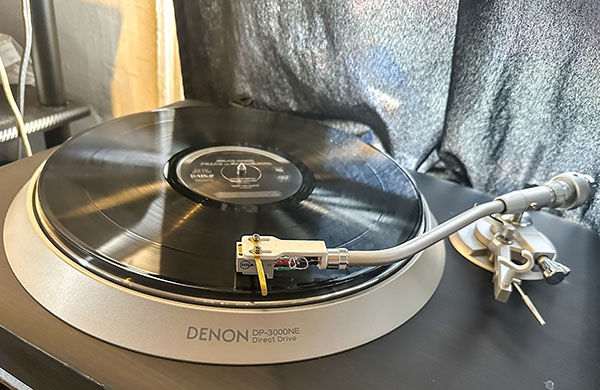
Miles Davis’ Filles de Kilimanjaro — a bold, avant-post-bop exploration — shone via the Denon/Dynavector duo, especially with the recent MoFi pressing’s hyper-detailed, expansive soundstage. The highs leaned bright and the bass stayed polite, but the Denon conjured a convincing 30th Street Studio vibe — images snapped into focus, with the energy intact.
By way of comparison, I lowered the needle on the admittedly more expensive Thorens/Korf assemblage. As expected, the Swiss legend dug deeper — pacing was tighter, the stage vast and immersive, and dynamics fluid and electrifying. Yet the more affordably priced Denon/Dynavector team revealed its own strength: dead silence. Its smaller, less expansive stage was quieter, letting me hear further into the music. Decades of Denon engineering don’t lie — the DP-3000NE table is a solid performer.
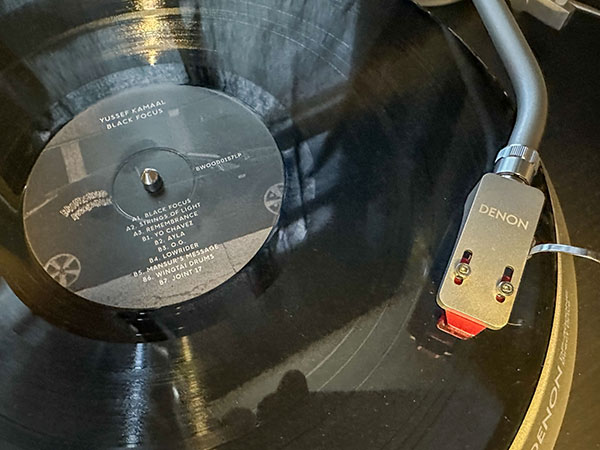
The title track to Yussef Kamaal’s Black Focus (Side A, Track 1) tested the Denon/Dynavector with its relentless 4/4 bass drum battering. The response? Tight, atmospheric, and punchy — if not especially deep. The Denon/Dyna pairing nailed the attack and energy, but the soundstage was a bit shallow, and images clipped. Dynamic, yes; expansive, no.
Carmen McRae, one of my favorite jazz vocalists, emits her casual, nonchalant brilliance on Book of Ballads, and the Denon/Dyna matchup beautifully captured her swinging intent — warm vocals, tonal intimacy, and a compelling sound that was slightly bright on top. The DP-3000NE portrayed Carmen as a solid being in my room, singing to me alone. The table’s excellent sense of quietude and pacing made the most out of this 65-year-old recording.
Replacing the Dynavector cart with the four-times-more-expensive Kuzma CAR-30 MC cart elevated the DP-3000NE’s performance. The table’s inherent transparency and superior build quality fully leveraged the Kuzma. Playing the drum and bass experimentation of “Black Focus,” the drums now hit with a visceral punch and depth, and a taut, muscular sonic grip. The kick drum, in particular, was no longer just a soft thump; it was a round, resonant thud with a crisp, percussive beater attack. The electric bass wasn't just low; it was a down-and-dirty, subterranean and thick, the kind of subbass you might feel in a techno club. And the Rhodes piano finally revealed its soul: all twinkling, crystalline tones and lush perspectives. The music had a newfound grit, viscosity, and depth. It felt rounder, more natural, and utterly whole.
The MoFi Miles Filles disc now had girth, presence, and a visceral solidity. The formerly truncated, anemic images were now pumped up and bristling with surreal sounds. Miles’ trumpet keened through a larger, deeper image, its tonality richer and the soundstage vastly expanded. The Denon/Kuzma duo unlocked the fiery goodness and sweet ’60s sonority of Miles’ music, delivering a sound that was both powerful and pure.
Conclusions
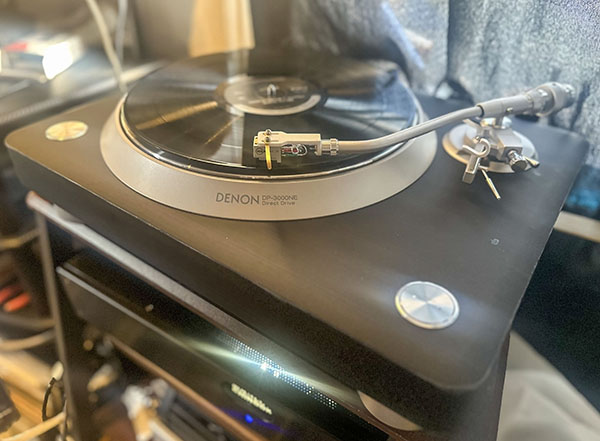
Though the Denon DP-3000NE turntable must be paired with a good cart to achieve its full potential, its basic build quality is solid, its sound refined and quiet, and its pacing bound by its direct-drive motor, but fully engaging and complementary.
For additional price-point context, consider the following. A Rega Planar 6 turntable will set you back $2,600, while a MoFi Electronics UltraDeck table sets a mean bar at $2,500, Meanwhile, a Clearaudio Concept MC Wood turntable with an MC cart — similar to the Clearaudio Concept Active model I reviewed and loved on our sister site Stereophile here — also goes for $2,600. Given this quite affordable turntable cost neighborhood and how well this new model performed, we think it’s a good idea if you add the Denon DP 3000NE to your short list.
For more about Denon, go here.
To find an authorized Denon retailer, go here.
Author bio: Former musician, former artist, and former legal wastrel Ken Micallef has written numerous hi-fi equipment reviews for Stereophile and Analog Planet, and his byline has also appeared within Mojo, Electronic Musician, and The Grammys. You can also find him at YouTube (Ken Micallef Jazz Vinyl Audiophile).
Footnote 1: AP editor Mike Mettler adds: If you want to read more about Ken’s late-night NYC DJing adventures, go here to follow his firsthand account of one such night, which we posted on March 24, 2025.




















 |
Equipment Reviews | |
The Gruvy Awards | |
Blogs Analog Tips | Columns Music | |
Show Reports | |
News Resources |
 © 2026 AnalogPlanet
AVTech Media Americas Inc.
All rights reserved